Honestly, learning Hebrew doesn't have to be expensive or painful. You don't need a fancy course, and you definitely don't need to spend hours staring at grammar tables. What you actually need are small, daily habits that pull the language into your normal life. Below are nine things I've used myself, or watched friends use, that genuinely work. Pick one, try it for a week, and see what happens.
1. The Power of Repetition
Your brain forgets fast. That's not a flaw, it's just how memory works. You can sit down and learn 500 words in a single afternoon, but if you never see them again, most of them will be gone by next weekend. The fix is small and a little boring: review a little, every day. Five minutes with flashcards beats a two-hour cram session you only do once a month. It sounds too simple to work. It works.
2. Sticky Notes Around the House
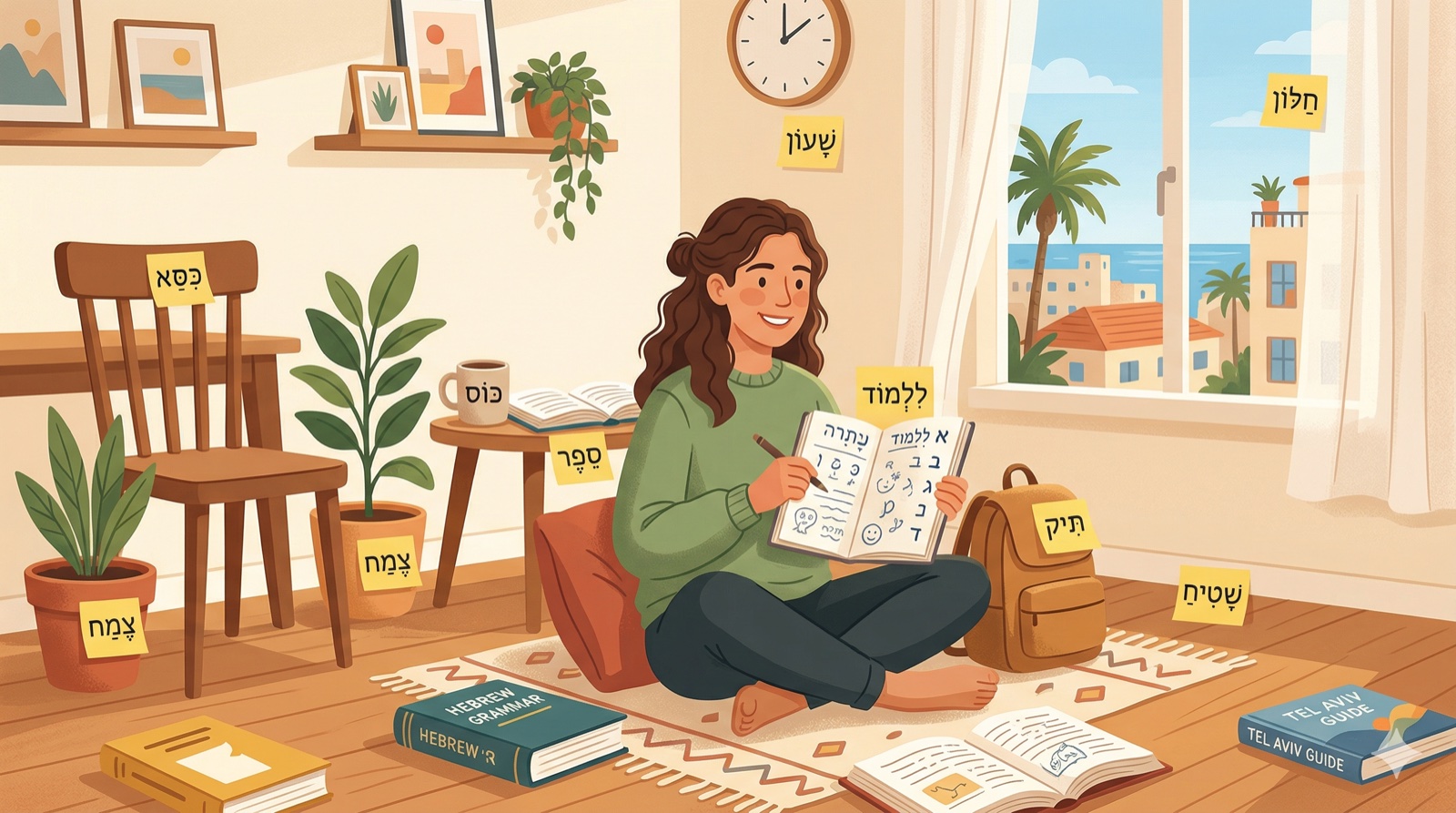
Instead of chasing words, let the words come to you. Grab a stack of sticky notes, write the Hebrew name of an object on each one, and stick them to the actual things in your house. Walk past the chair, read it out loud. Open the fridge, read that one too. Even if you feel a bit silly at first, just say it.
For example, the Hebrew word for chair is kiseh (כִּסֵּא). Stick a note on a chair you actually sit in every day. Within a week, you won't need the note anymore.
3. Make Your Lists in Hebrew
Going to the supermarket? Packing for a trip? Write the list in Hebrew. It sounds like a tiny thing, but it quietly flips you from passively studying the language to actually using it.
- 5 Melafefonim (cucumbers)
- 4 Agvaniyot (tomatoes)
- 1 Tapuach (apple)
- 2 Gzarim (carrots)
After a few weeks, drop the English in the brackets. You'll be surprised how quickly the words start feeling automatic.
4. Touch It, Name It
Whenever your hand touches something, name it in Hebrew out loud. Putting on a shirt? Chultza (חֻלְצָה). Picking up a cup? Kos (כּוֹס). Don't know the word yet? Look it up right then. That single lookup, the one tied to a real, physical moment, sticks much better than the same word read off a list.
5. Watch Hebrew Content (Even If You Don't Understand It)
You don't have to understand every word. Just listen. YouTube, Israeli series on Netflix, Hebrew podcasts, all of it counts. Start with kids' shows, where the vocabulary is slower and simpler, and move on to dramas with Hebrew subtitles when you feel ready. Your ear catches on faster than you'd expect.
Pair it with the phrases section on Heb4You and you'll start recognizing pieces of what you hear surprisingly fast.
6. Find a Language Partner
Twenty minutes of real conversation a week beats hours of studying alone. Apps like Tandem, HelloTalk, and Speaky make it easy to find Israelis who want to practice your language in exchange for theirs. The first conversation will be awkward. The fifth one won't.
7. Use AI as a Patient Tutor
This one is newer, and I really like it. ChatGPT (or any modern AI) is basically a free tutor that never gets bored or impatient. Ask it to quiz you, correct your sentences, or roleplay a conversation in Hebrew: ordering food, asking for directions, anything you'd actually say in real life. It won't laugh at your mistakes, which makes those awkward first weeks a whole lot easier.
8. Visit Israel (Or Volunteer There)
Nothing, and I mean nothing, beats actually being here. A couple of weeks in Tel Aviv, Jerusalem, or a kibbutz will move your Hebrew further than months of study at home. If money is the issue, look into kibbutz volunteer programs or Masa Israel. Both offer affordable ways to live in the country while learning the language at the same time.
9. Be Consistent, Not Perfect
If there's one tip on this list that matters more than the rest, it's this one. The people who actually learn a language aren't the ones with the most talent. They're the ones who show up every single day. Ten minutes a day will take you further than two hours once a week, every time. Pick a time, stick to it, and trust that the small effort adds up. It really does.
Ready to start practicing?
Browse Heb4You's free vocabulary topics with picture cards and native audio.
Browse Topics