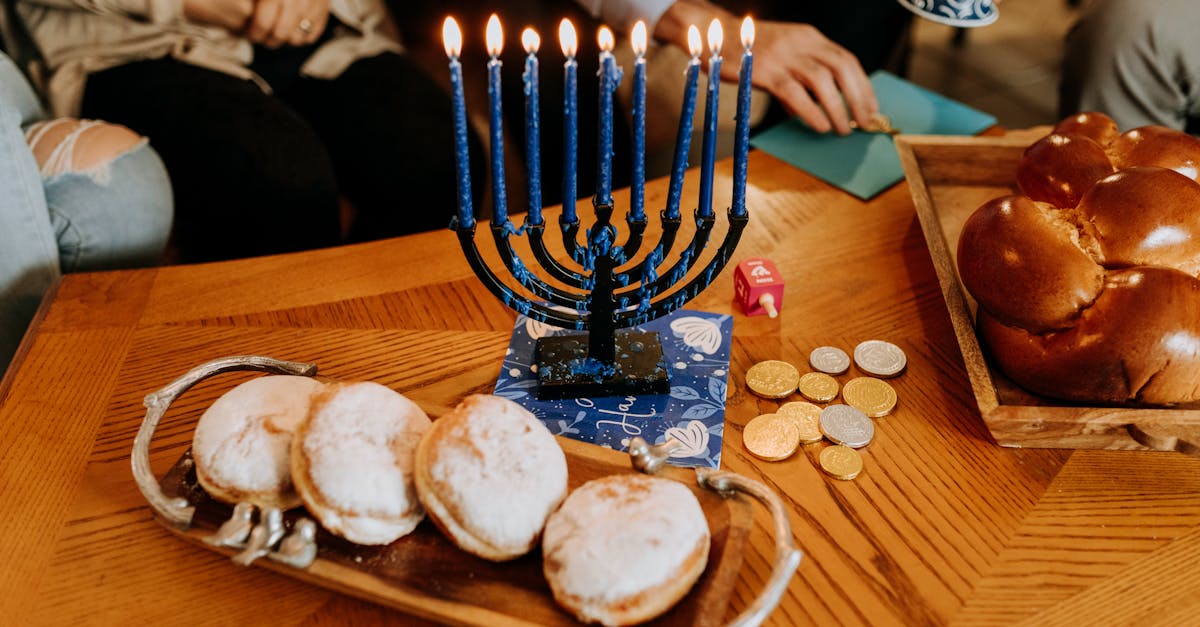
Hanukkah is the Jewish holiday most non-Jews know at least a little about, usually because of the candles and the dreidel. But if you want to actually understand what's happening during the eight nights, a small Hebrew vocabulary goes a long way. Here are the songs, blessings, and vocab you need to follow along, or to host your own Hanukkah.
The basics
- Chanukah (חֲנֻכָּה), Hanukkah. Literally "dedication", referring to the rededication of the Temple in ancient Jerusalem.
- Ner, candle. Nerot, candles.
- Chanukiya, the nine-branched candle holder used on Hanukkah. (This is technically different from a menorah, which has seven branches.)
- Shamash, the "helper" candle that lights the others.
- Shemen, oil. The miracle of Hanukkah involves a small jar of oil that lasted eight days.
The candle-lighting ritual
Each night for eight nights, you light one more candle using the shamash. Night one: one candle. Night two: two candles. And so on until night eight, when all eight are lit along with the shamash.
The candles are placed right to left, but lit left to right, so the newest candle is always lit first. Little details like this are what make Jewish ritual feel layered and thoughtful.
The blessings
There are three blessings on the first night and two on every subsequent night. The main ones:
- Baruch atah Adonai Eloheinu melech ha-olam, asher kidshanu be-mitzvotav ve-tzivanu le-hadlik ner shel Chanukah. "Blessed are you, God, King of the universe, who has sanctified us with his commandments and commanded us to light the Hanukkah candle."
- Baruch atah Adonai Eloheinu melech ha-olam, she-asah nisim la-avoteinu ba-yamim ha-hem bi-zman ha-zeh. "Who performed miracles for our ancestors in those days, at this season."
Don't worry about pronouncing these perfectly. Even Israelis stumble over them the first few times. The rhythm and the family watching are what matter.
The food
Hanukkah has two classic foods, both deep-fried in oil to commemorate the miracle:
- Sufganiyot (סֻפְגָּנִיּוֹת), jelly-filled donuts. Israeli bakeries start selling these weeks before Hanukkah, and there's a national debate about which bakery makes the best ones.
- Levivot, potato pancakes. Known as latkes in Yiddish. Usually served with sour cream or applesauce.
If you visit an Israeli bakery in December, the sufganiyot display will be a riot of colors and fillings. Classic strawberry jam, dulce de leche, pistachio, chocolate, and increasingly wild flavors.
The dreidel
The sevivon (סְבִיבוֹן), known as dreidel in Yiddish, is a spinning top with four Hebrew letters on its sides: nun, gimel, heh, and shin. These stand for "nes gadol hayah sham" (a great miracle happened there). In Israel, the last letter is pe instead of shin, standing for "here" instead of "there", because the miracle happened in Israel.
Kids play a gambling game with the dreidel using chocolate coins (matbe'ot shokolad) as currency. Each letter tells you what to do with the pot.
The songs
Two songs you'll hear everywhere during Hanukkah in Israel:
- Maoz Tzur, "Rock of Ages". An ancient hymn sung after lighting the candles.
- Sevivon sov sov sov, "spin, spin, spin, little dreidel". The children's song every Israeli kid knows by heart.
Even secular Israelis sing these in December. You'll hear them in daycares, family gatherings, and radio specials.
Greetings
- Chanukah sameach, happy Hanukkah. The universal greeting.
- Chag urim sameach, "happy festival of lights".
Both work. Chanukah sameach is more common in daily speech.
How Israelis celebrate
Hanukkah in Israel is more family-focused than religious. People:
- Light candles in their windows each night (for all eight nights).
- Eat a lot of sufganiyot.
- Visit family, especially grandparents.
- Give small gifts, often money (dmei chanukah).
- Take the kids to special Hanukkah events at museums and parks.
The mood is warm and light, and Tel Aviv in December is full of candle-lit windows and the smell of fried dough.
For more holiday vocabulary, our topics pages include seasonal words, and our phrases section has festive greetings with audio.
Light a candle, eat a sufganiya, say chanukah sameach. That's the whole holiday.
Ready to start practicing?
Browse Heb4You's free vocabulary topics with picture cards and native audio.
Browse Topics